El Paso sits on the Hueco Bolson, a deep basin filled with alluvial and fluvial deposits that can surprise you during excavation. We've measured groundwater as shallow as 15 feet in the downtown corridor, which changes the game for any project deeper than a single story. The mix of silty sands and clay layers, combined with a seismic environment where ASCE 7-22 maps the city in a zone with peak ground accelerations around 0.15g, makes a proper deep excavation design non-negotiable. Our lab runs the full suite of soil strength tests because the stratigraphy here can flip from stiff to loose in less than three vertical feet. When the borehole logs come back, we often find the need to pair the excavation plan with a liquefaction assessment to address the saturated granular layers that show up across the Lower Valley.
In the Hueco Bolson, the difference between a stable cut and a blowout often comes down to one thin clay seam we catch in the lab.
Methodology and scope
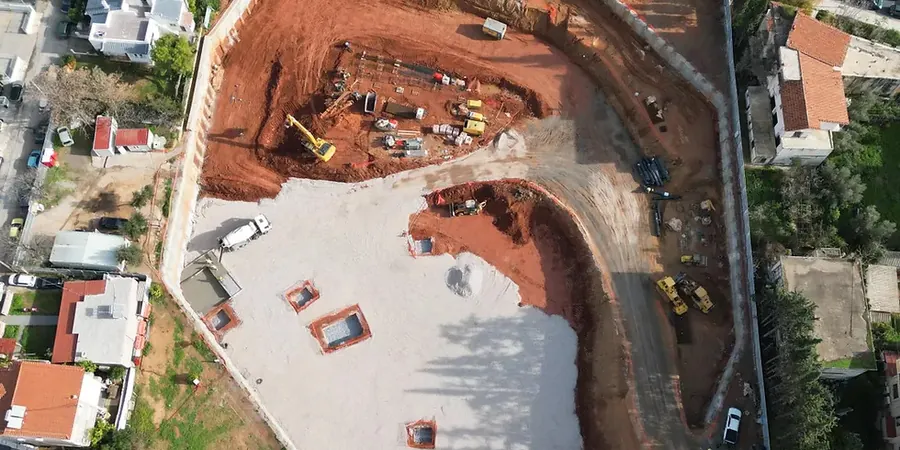
Local considerations
The risk profile changes dramatically between a site on the East Side and one near the Rio Grande. On the East Side, you're dealing with thicker unsaturated zones and a lower chance of basal heave, but the silty sands can ravel fast if the lagging isn't installed tight. Along the river, the water table sits high and the fine-grained soils have almost zero stand-up time. We've seen a trench collapse in the Upper Valley where the contractor misjudged the cohesion of a sandy lean clay by just 50 psf. Our designs specify a minimum factor of safety of 1.5 for rotational failure and 2.0 for basal heave under undrained conditions. For excavations deeper than 20 feet next to existing structures, we run a damage class assessment per the old FHWA guidelines to set the green, yellow, and red thresholds for ground movement before the first shovel hits the dirt.
Applicable standards
ASTM D7181 (Consolidated Drained Triaxial for design parameters), IBC 2024 Chapter 18 (Excavation and Shoring), FHWA GEC No. 2 (Earth Retaining Structures), ASCE 7-22 (Seismic Earth Pressures), ASTM D2487 (Unified Soil Classification for stratigraphic profiling)
Associated technical services
Shoring and Bracing Design
We size soldier piles, walers, struts, and tiebacks based on effective stress parameters from your site's triaxial and direct shear results. Designs include staged excavation analysis and deflection estimates.
Dewatering and Cut Stability
Using in-situ permeability data and grain-size curves, we design the dewatering array and check bottom stability against heave and piping, especially where the water table is within the cut depth.
Typical parameters
Frequently asked questions
What's the ballpark cost for a deep excavation design in El Paso?
For a standalone geotechnical design package covering shoring, dewatering, and stability analysis, the fee typically runs between US$2,010 and US$8,520 depending on the cut depth and how many stages we need to model. A 15-foot single-stage cut is on the lower end; a 40-foot cut with tiebacks and adjacent building surcharges is on the higher end.
How do you handle the cobbles in the Camp Rice Formation for shoring design?
We start with a test pit or large-diameter bucket auger to characterize the cobble size and frequency. If the cobbles are bigger than 6 inches, we typically shift from driven piles to drilled shafts or specify a pre-drill through the cobble zone. The lateral resistance doesn't change much, but the installation method drives the constructability section of the design.
Do I need a dewatering plan for a basement excavation in central El Paso?
If you're digging deeper than 12 to 15 feet, almost certainly yes. The groundwater in the downtown and river-adjacent areas is shallow and seasonal fluctuations can bring it up a couple of feet in the summer monsoon. We'll install a couple of piezometers during the site investigation to get the real number before finalizing the design.
Which soil parameters matter most for the lateral earth pressure calculation?
The effective friction angle and the soil-wall interface friction are the big two. We get those from consolidated-drained triaxial tests at the right confining pressure, not from correlations. For the active pressure in silty sands, a half-degree error in phi changes the total load by about 3 to 5 percent, which adds up on a 30-foot wall.