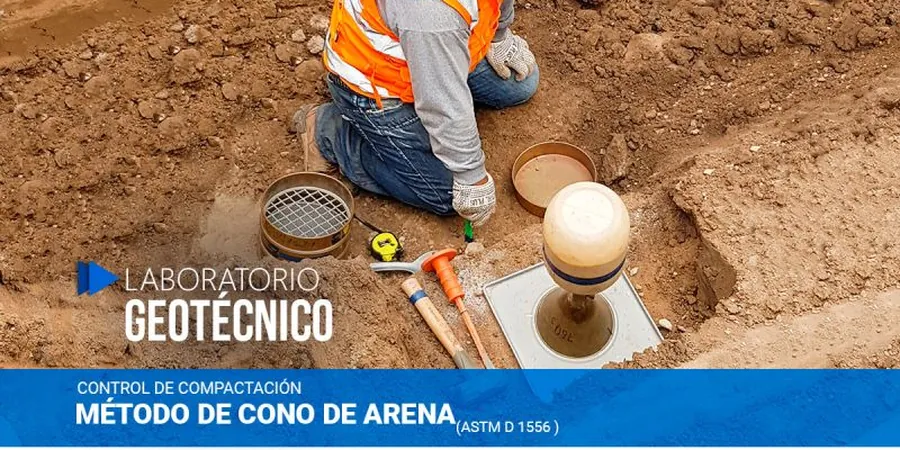
El Paso’s Chihuahuan Desert setting, with its flash-flood arroyos and expansive caliche layers, puts a unique demand on compaction verification. A fill that looks tight after a few scraper passes can easily be hiding loose pockets once the summer monsoons hit and runoff concentrates against a foundation. That’s why we run the sand cone density test directly on the grade, giving you a defensible number for the city inspector before you pour. The method follows ASTM D1556 / AASHTO T-191, and our lab operates under ISO/IEC 17025 accreditation, so the data holds up whether you’re working a TxDOT embankment, a Westside hillside pad, or a trench backfill in the Rio Grande alluvium. When the reference proctor is in question, we pull a Proctor curve from the same borrow source to make sure the relative compaction percentage isn’t chasing a wrong target.
In desert fill, a two‑percent swing in relative compaction can decide whether a slab stays flat or cracks after the first monsoon.
Methodology and scope
Local considerations
El Paso’s growth since the 1960s has pushed residential pads onto foothill colluvium and old arroyo fans that weren’t always mapped before grading. When a developer cuts and fills across these geologies without a consistent density‑test plan, the differential settlement shows up fast—think slab corners that drop half an inch relative to the garage stem wall. The sand cone test on compacted fill is the direct evidence that the placed material meets the structural spec, and it’s the record the city’s building‑official wants to see before signing off a compaction report. In a region where the seismic hazard is moderate but real, and where expansive smectite clays exist in pockets from the Santa Fe Group, skipping a field density check on a key lift can turn a warranty issue into a structural repair.
Explanatory video
Applicable standards
ASTM D1556 / AASHTO T-191 – Sand Cone Method, ASTM D1557 – Modified Proctor (reference density), City of El Paso – International Building Code amendments (IBC 2021)
Associated technical services
Pad & Slab Density Testing
Point tests every 2,500 sq ft or per the geotechnical report on building pads, with same‑day wet density and relative compaction reports submitted to the project engineer.
Utility Trench Backfill Verification
Sand cone tests at pipe zone and above‑pipe lifts, following City of El Paso Standard Detail 500‑series specs, so the trench passes compaction inspection before paving.
Borrow Source & Proctor Correlation
When the borrow pit changes, we run a new lab Proctor and correlate it with field sand cones, preventing the false failing numbers that come from a mismatched reference curve.
Typical parameters
Frequently asked questions
How much does a sand cone density test cost in El Paso?
A single test on a residential pad typically runs between US$90 and US$150, depending on access and how many lifts need testing in one visit. Larger subdivision programs are priced by the day with a minimum number of tests.
Why use the sand cone method instead of a nuclear gauge in El Paso?
Nuclear gauges struggle in soils with high iron content or scattered caliche rock, both common across the El Paso basin. The sand cone gives a direct mass‑volume measurement unaffected by mineralogy, and it avoids the regulatory paperwork tied to radioactive sources on site.
How many tests do I need for a house slab?
The City of El Paso generally requires one field density test per lift per 2,500 square feet, but the exact number comes from the geotechnical engineer’s observation schedule. We follow that schedule and add tests if the fill material changes visibly between lifts.
Can you test compaction on caliche fill?
Yes—we test caliche fill regularly. The key is using a Proctor curve developed on the same caliche borrow material, because caliche-specific maximum dry density can be several pounds per cubic foot lower than a standard sand‑gravel curve would suggest.
How soon after compaction can you run the test?
The test can be performed immediately after the compactor lifts off, as long as the surface is stable enough to dig a clean test hole without sloughing. We usually schedule the sand cone within the same shift that the lift is placed, so re‑compaction can happen the same day if results fall below spec.