When a contractor broke ground on a drainage tunnel near the Rio Grande floodplain last year, the first 15 feet of excavation revealed exactly what local drillers have long understood: El Paso’s basin-fill deposits can transition from stiff clay to loose silty sand in less than three vertical feet. The city sits at roughly 3,800 feet elevation within the Rio Grande Rift, where Quaternary alluvium and interbedded lacustrine clays form the upper 100 to 300 feet of the subsurface profile. For any tunnel alignment passing through these materials, standard rock-mass classifications become irrelevant. The analysis instead relies on in-situ permeability measurements to predict face seepage, combined with triaxial consolidated-undrained testing to capture the undrained shear strength that governs stand-up time in low-cohesion soils.
In El Paso basin clays, a 2% misjudgment in undrained shear strength can double the predicted settlement trough width.
Methodology and scope
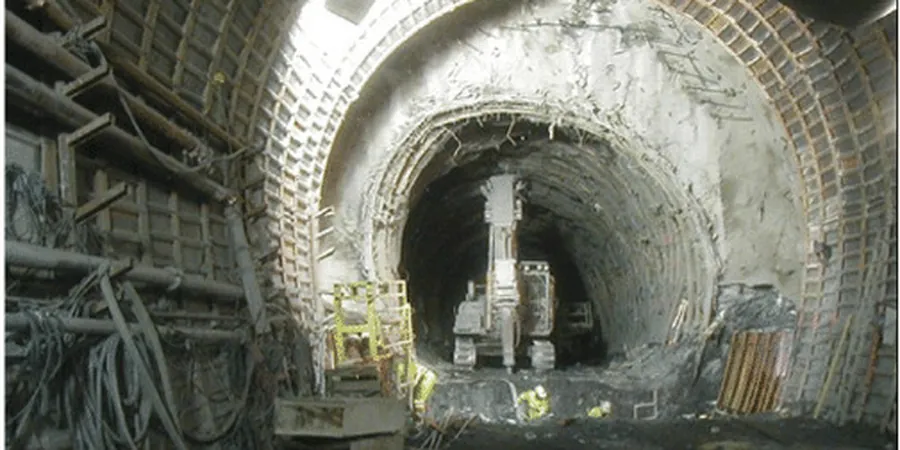
Local considerations
The Paso del Norte basin sits within Seismic Design Category C under ASCE 7, with the East Franklin Mountains fault system capable of generating moderate-magnitude events that amplify ground deformation in saturated silts. While liquefaction potential is lower here than in coastal California, the interbedded nature of the basin-fill means that thin sand lenses encased in low-permeability clay can develop excess pore pressure during shaking, leading to buoyancy-driven flotation of tunnel segments. Face instability during excavation is the more immediate hazard: a tunnel crown in soft clay with Su below 500 psf can collapse within minutes if the unsupported span exceeds critical length. Our analysis calculates that span using plasticity solutions calibrated to local case histories, factoring in surface surcharge from adjacent buildings and the weight of construction equipment staging yards.
Applicable standards
ASTM D2487-17e1, ASCE 7-22, ASTM D4767-11, IBC 2021 Chapter 18
Associated technical services
Laboratory strength and consolidation testing
We run CIU triaxial and one-dimensional consolidation tests on undisturbed Shelby tube samples to define the critical-state parameters and consolidation behavior that control tunnel crown settlement.
In-situ pore pressure and permeability assessment
Using vibrating-wire piezometers and falling-head tests in boreholes, we map the seasonal groundwater regime that dictates dewatering requirements and face stability calculations.
Numerical settlement trough modeling
We build 2D and 3D finite-element models using PLAXIS or FLAC, calibrated to site-specific soil parameters, to predict surface settlements and assess risk to adjacent infrastructure like I-10 overpass footings.
Typical parameters
Frequently asked questions
What is the typical lead time for a tunnel geotechnical analysis in El Paso?
A full analysis that includes drilling, undisturbed sampling, laboratory strength testing, and numerical settlement modeling generally requires four to seven weeks depending on site access and the depth of the proposed tunnel alignment.
What does geotechnical analysis for soft soil tunnels cost in El Paso?
Based on projects completed in the El Paso area, the analysis typically ranges from US$4,810 for a limited investigation of shallow utilities to US$17,820 for a comprehensive program involving multiple boreholes, advanced triaxial testing, and detailed finite-element modeling.
How do you account for the Rio Grande's influence on tunnel design?
The river and its associated irrigation canals create a perched groundwater condition in parts of the Mission Valley. We install multi-level piezometers to distinguish between shallow perched water and the deeper regional aquifer, so that face support pressures are designed for the actual hydraulic head at tunnel depth rather than an assumed uniform phreatic surface.