The Chihuahuan Desert gives El Paso a unique set of ground conditions. The intense summer heat, sparse but torrential monsoon rains, and the city's position along the Franklin Mountains create a landscape of steep slopes and deep arroyos. We design retaining walls that have to handle flash flood erosion, highly expansive clay pockets, and the lateral pressure from poorly graded sandy silts typical of the basin. When the monsoon hits a slope in the Upper Valley, a poorly designed wall can fail in hours. That's why our approach starts with a detailed look at the soil profile. A proper wall here isn't just a concrete barrier; it's a drainage system and an erosion control measure built into one. Often, we combine the wall design with a slope stability assessment to make sure the entire landform stays put, not just the structure itself.
A retaining wall in El Paso must work as a drainage system first and a structural element second. If water can't escape, the wall will eventually move.
Methodology and scope
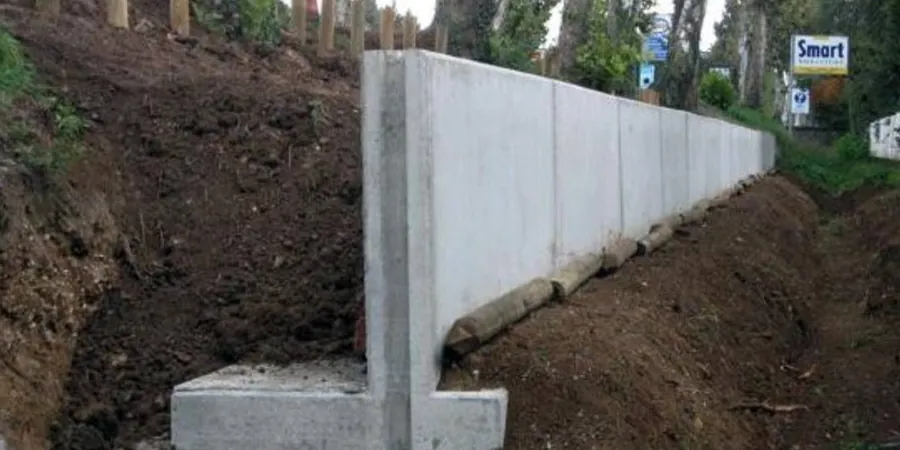
Local considerations
El Paso's development has pushed steadily into the bajadas and mountain foothills over the last fifty years. Many residential lots are cut into the natural slope, leaving a steep back-cut that needs a wall. The biggest risk we see isn't the wall itself failing, but the slope above it becoming unstable after a heavy rain. The city's expansive clays can shrink and crack, letting water infiltrate deep behind the wall structure. Without a properly designed drainage blanket and weep holes, that water pressure builds up fast. We also look at global stability; a wall might be perfectly engineered, but if the entire slope is creeping, the wall goes with it. We apply a minimum factor of safety of 1.5 for static conditions and 1.1 for seismic, as required by the IBC, and we always recommend a graded swale at the top to divert surface runoff away from the backfill zone.
Explanatory video
Applicable standards
IBC 2021, Chapter 18, ASCE 7-22, Chapter 11 (Seismic), ASTM D2487 (Soil Classification), AASHTO LRFD 2020 (Section 11)
Associated technical services
Site Investigation
We log the soil profile using test pits or borings, classifying materials per ASTM D2487 and measuring in-situ density.
Geotechnical Design
We calculate lateral earth pressures, check bearing capacity and sliding, and size the stem and footing for reinforced concrete walls.
Drainage Design
We detail the drain pipe layout, filter fabric, and cleanouts to ensure the wall stays free of hydrostatic pressure long-term.
Construction Review
We observe backfill placement and compaction during construction to verify the work matches the design intent and specifications.
Typical parameters
Frequently asked questions
What do retaining wall design services cost in El Paso?
For a typical residential or light commercial wall in the El Paso area, design fees range from US$1,010 to US$4,080. The final figure depends on the wall height, the complexity of the soil profile, and whether a slope stability analysis is also required.
How deep should a retaining wall footing be in El Paso?
It depends on the soil, but we typically set footings at least 24 to 30 inches below finish grade to get below the zone of seasonal moisture fluctuation. In expansive clay areas, we may go deeper or specify a gravel sub-base to isolate the footing from the active soil zone.
Do all retaining walls in El Paso need a building permit?
Walls over 4 feet in height measured from the bottom of the footing to the top of the wall generally require a permit and sealed engineering plans. We prepare the structural calculations and drawings that the city requires for plan review.