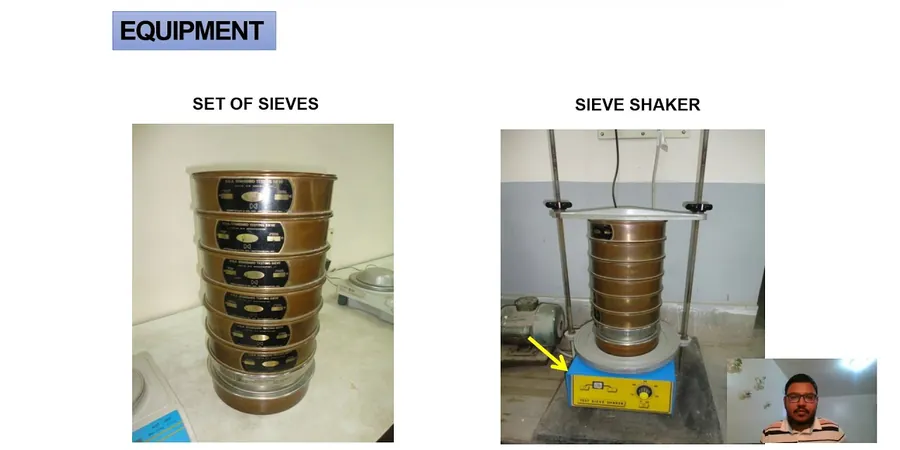
The Franklin Mountains cut through the center of El Paso, shedding coarse alluvial fans that transition abruptly into the silty-clay deposits of the Rio Grande floodplain. This sharp geological contrast—from gravelly bajada to fine basin fill—means a single boring can encounter everything from cobbles to plastic clay within 30 vertical feet. A complete grain size analysis using both sieve stacks and the hydrometer method becomes essential for classifying these interlayered deposits under the Unified Soil Classification System. Our laboratory runs ASTM D6913 for the coarse fraction retained on the No. 200 sieve and ASTM D7928 hydrometer sedimentation for the fines, delivering a continuous particle-size distribution curve that geotechnical engineers rely on for seepage modeling, liquefaction screening, and compaction specification in the Paso del Norte region.
The No. 200 wash is a screening tool, not a design parameter—without the full hydrometer curve, you are guessing at the clay fraction that controls both drainage and volume change in El Paso's basin clays.
Methodology and scope
Local considerations
El Paso's climate swings from single-digit humidity in May to near-saturation during the July–September monsoon, when arroyos that were bone-dry for eleven months suddenly carry sheet flow across construction sites. This extreme moisture cycling disproportionately affects fine-grained soils whose engineering behavior is governed by the clay-size fraction—exactly the portion quantified by the hydrometer analysis. A soil classified as silty sand (SM) with 8% clay will perform vastly differently than one with 14% clay, even though both pass the same field identification tests. Overlooking the hydrometer step on a detention-basin project in the lower valley, for instance, can lead to seepage rates off by an order of magnitude. The IBC-mandated site classification also ties directly to gradation parameters: fine content and plasticity influence the seismic site class under ASCE 7-22, and El Paso lies within a zone where basin amplification effects can lengthen ground-motion duration during distant Chihuahua-trench events.
Applicable standards
ASTM D6913-22: Standard Test Methods for Particle-Size Distribution (Gradation) of Soils Using Sieve Analysis, ASTM D7928-21e1: Standard Test Method for Particle-Size Distribution (Gradation) of Fine-Grained Soils Using the Sedimentation (Hydrometer) Analysis, ASTM D2487-17e1: Standard Practice for Classification of Soils for Engineering Purposes (Unified Soil Classification System)
Associated technical services
Complete Sieve Analysis with Hydrometer
Combined ASTM D6913/D7928 package yielding a continuous gradation curve from the 3-inch sieve down to the clay colloid range. Includes calculation of D10, D30, D60, uniformity coefficient (Cu), coefficient of curvature (Cc), and gravel-sand-silt-clay percentages. Suitable for foundation design, seepage analysis, and liquefaction screening per NCEER methodology.
Washed No. 200 Fraction and Material Finer
Rapid determination of the minus No. 200 fraction by wet sieving per ASTM D1140. Used for quality control on aggregate base course and as a preliminary screening tool before full hydrometer analysis. Common for TxDOT subgrade verification on El Paso District projects.
Typical parameters
Frequently asked questions
Why do I need both sieve analysis and hydrometer for my El Paso project?
The sieve analysis stops at the No. 200 sieve (0.075 mm), which only tells you the total percentage of fines. The hydrometer continues the curve down to roughly 0.001 mm, separating the silt-sized particles from the true clay fraction. In El Paso's basin-fill deposits, the clay percentage controls permeability, shrink-swell potential, and the soil's response to monsoon saturation—parameters that a sieve-only report simply cannot provide.
How much sample material do you need for a complete gradation test?
The minimum mass depends on the nominal maximum particle size, following Table 1 of ASTM D6913. For a soil with gravel up to 19 mm (3/4 inch), we typically need about 5 kg of material. For finer sands and silts, 500 grams is often sufficient. We can provide container specifications and sampling guidance before you mobilize the drill rig.
What is the typical cost for a sieve plus hydrometer analysis in El Paso?
A complete ASTM D6913/D7928 combined analysis generally falls in the range of $90 to $200 per sample, depending on the number of sieves required, the hydrometer reading schedule, and whether the sample needs pre-treatment for organics or salts. We provide firm quotes based on the project specification and anticipated soil types.
How do you handle soils with high gypsum or soluble salts, which are common in the El Paso basin?
El Paso's Hueco Bolson contains significant evaporite horizons with gypsum and soluble salts. For these soils, we pre-wash the sample and, when specified, perform the hydrometer analysis using distilled water to avoid flocculation from dissolved ions. If the project requires it, we can also run a separate soluble-sulfate content test to complement the gradation data and inform concrete exposure class selection. More info.