El Paso sits at roughly 3,740 feet in the Chihuahuan Desert, where the Rio Grande Valley conceals a complex stratigraphy of Holocene alluvium and older basin-fill deposits that can exceed 1,000 feet in thickness. When a new distribution center off I-10 encountered loose silty sands with SPT N-values below 8 below 15 feet, the structural loads could not be supported on conventional shallow footings without risking excessive differential settlement. Our team designed a grid of vibro replacement stone columns extending through the compressible zone to transfer loads to a denser Pleistocene layer, increasing the composite ground stiffness by a factor of 2.5 while keeping the project within the original earthwork budget. That is the practical value of an engineered ground improvement strategy: it converts a marginal site into buildable terrain without removing and replacing 20,000 cubic yards of material. We combine site-specific CPT soundings with our SPT drilling data to calibrate the column length, diameter, and spacing so that post-treatment settlement stays under 1 inch for the design life of the structure.
A well-designed stone column grid doesn't just carry the load — it drains the earthquake before the pore pressure can erase the soil's strength.
Methodology and scope
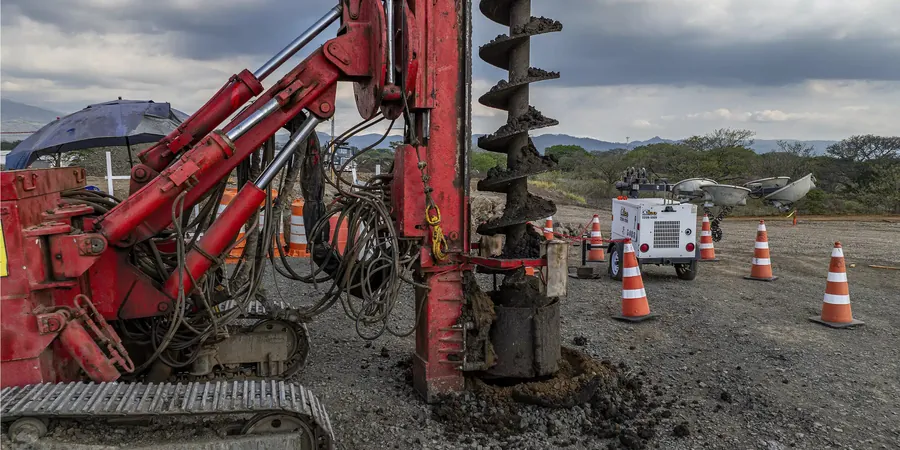
Local considerations
Basin-fill soils in El Paso present a dual hazard: collapsible silts in the upper 10 feet that densify abruptly when wetted, and deeper saturated sands that can liquefy under the 0.15–0.25g peak ground accelerations expected from range-front faults like the Franklin Mountains fault system. A single monsoon season can introduce enough water through utility trenches to trigger hydroconsolidation under a slab-on-grade, producing 4 inches of differential movement that tears partition walls and binds overhead doors. We approach stone column design here with two objectives: drain potential excess pore pressure during a seismic event, and reinforce the soil matrix so that even if partial collapse initiates, the load redistributes to the gravel columns through arching. For a recent tilt-wall warehouse near the Zaragoza port of entry, the combination of 30-inch diameter columns on a 7-foot triangular grid and a compacted structural fill platform reduced the calculated post-liquefaction settlement from 5.5 inches to less than 1 inch, satisfying the performance criteria of ASCE 7-22 without switching to a deep foundation system.
Applicable standards
IBC Chapter 18 (2024 edition), FHWA-NHI-16-027 Ground Improvement Manual, ASTM D1586 Standard Test Method for SPT, ASTM D6913 Grain-Size Analysis, ASCE 7-22 Seismic Provisions
Associated technical services
Feasibility Analysis and Preliminary Design
We screen the site using CPT and SPT data to determine if vibro replacement is viable. The deliverable is a design memorandum with column depth, spacing, area replacement ratio, and settlement estimates for the design earthquake.
Construction-Phase Testing and Special Inspection
We act as the owner's representative during installation, logging stone take, recording amperage and depth, and executing post-installation plate load tests to confirm that the treated ground meets the specified modulus.
Typical parameters
Frequently asked questions
How much does a stone column design package for an El Paso commercial lot cost?
A complete design package — including feasibility review, preliminary layout, final design report with specifications, and two site visits during construction — typically ranges from US$1,500 to US$4,980 depending on the building footprint and the complexity of the subsurface profile. Sites with highly variable alluvium or proximity to the river channel require more modeling effort and fall toward the upper end.
What makes stone columns suitable for the silty sands found in the El Paso Lower Valley?
The Lower Valley alluvium often contains 15 to 35 percent fines, which places it near the upper limit for conventional vibro replacement. We address this by designing a slightly larger diameter column and reducing the spacing to maintain a consistent area replacement ratio. The gravel column also acts as a vertical drain, so even if the silt fraction slows dissipation, the shortened drainage path keeps the reconsolidation time within acceptable limits for the design seismic event.
How do you verify that the installed stone columns perform as designed?
We specify a combination of modulus tests — typically a zone load test using a 30-inch diameter plate — and SPT or CPT soundings at the centroid between columns. The acceptance criterion is a minimum equivalent modulus of 200 ksf for footing support, measured no sooner than 48 hours after installation to allow for pore pressure dissipation. For liquefaction mitigation projects, we also compare pre- and post-treatment CPT tip resistance to confirm the increase in cyclic resistance ratio.