We were reviewing the subgrade for a new distribution center out near the Border Highway when the contractor mentioned he was surprised by how much the CBR value dropped after soaking. That's El Paso for you — arid most of the year, but when the monsoon hits, those silty sands along the Rio Grande floodplain can turn into a completely different material. The California Bearing Ratio test isn't just a number on a report; it tells you exactly how the formation will behave under traffic loads once water gets involved. We run the laboratory CBR per AASHTO T-193, compacting specimens at optimum moisture from a standard Proctor test and then submerging them for 96 hours to simulate worst-case field conditions. For projects east of the Franklins where the native soils are predominantly SM and SC per the Unified Soil Classification System, the soaked CBR often dictates the pavement section, and knowing that number early — before the flexible pavement design is locked in — can save thousands in over-excavation or aggregate base course.
Methodology and scope
Local considerations
El Paso sits at roughly 3,740 feet above sea level on the Chihuahuan Desert floor, and its pavement subgrades deal with a climate that swings from single-digit humidity to sudden cloudbursts that drop an inch of rain in an hour. The risk of skipping laboratory CBR testing is not theoretical — we have seen parking lots in the Eastlake area develop alligator cracking within two years because the designer assumed a CBR of 10% based on a visual classification of the sandy subgrade, when the soaked value was actually below 4%. AASHTO 1993 flexible pavement design is exquisitely sensitive to CBR when the value falls below 6%; the required structural number and aggregate thickness increase non-linearly. For rigid pavements, the modulus of subgrade reaction (k-value) is often correlated from CBR, and an overestimated CBR leads to under-designed slab thickness and uncontrolled transverse cracking. The City of El Paso requires a geotechnical report with laboratory CBR values for any commercial site plan submittal, and building officials in Horizon City and Socorro have started flagging designs that rely on assumed values rather than project-specific testing. The cost of the test is negligible compared to a premature pavement failure that disrupts business operations or requires an asphalt overlay within the warranty period.
Applicable standards
AASHTO T-193: Standard Method of Test for California Bearing Ratio, ASTM D1883: Standard Test Method for CBR of Laboratory-Compacted Soils, TxDOT Item 120: Subgrade Preparation and Compaction, ASTM D1557: Modified Proctor Compaction (correlated standard), AASHTO Guide for Design of Pavement Structures (1993)
Associated technical services
Soaked Laboratory CBR (AASHTO T-193)
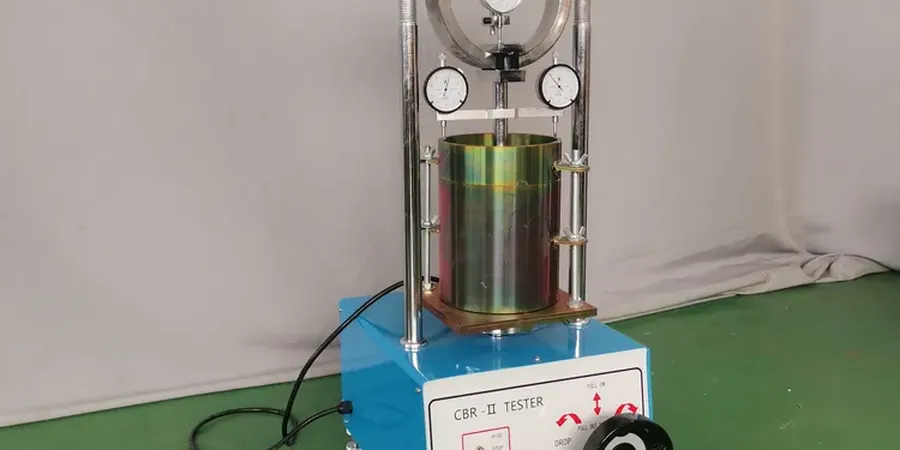
The standard test for pavement design in El Paso. Specimens are compacted at optimum moisture content, submerged for 96 hours, and penetrated at 0.05 in/min. We report CBR at 0.1 and 0.2 inches of penetration, plus the swell percentage during soaking — critical for expansive clays in the Upper Valley.
Three-Point CBR Curve
Three specimens compacted at different energy levels (typically 10, 30, and 65 blows per lift) to develop the CBR versus dry density curve. This lets the pavement designer specify a target field density that achieves the required CBR without over-compacting, which is especially useful in the silty sands east of Loop 375.
CBR with Resilient Modulus Correlation
For projects using the AASHTOWare Pavement ME Design software, we provide CBR values with correlated resilient modulus (Mr) using the NCHRP 1-37A relationship. This bridges the gap between the empirical CBR method and mechanistic-empirical design, which TxDOT is increasingly requiring for high-volume roadways.
Typical parameters
Frequently asked questions
What is the difference between soaked and unsoaked CBR in El Paso soils?
In the El Paso region, the difference can be dramatic. Unsoaked CBR values in the silty sands (SM) common along the I-10 corridor often range from 15% to 25%, but after 96 hours of soaking per AASHTO T-193, those same materials can drop to 3% to 8%. The expansive clays found in some areas of the Upper Valley and near the New Mexico state line show even more sensitivity, with soaked values sometimes falling below 2%. This is why TxDOT and the City of El Paso require soaked CBR for pavement design — the monsoon season and irrigation in landscaped medians introduce moisture that the subgrade will eventually see.
How much does a laboratory CBR test cost in El Paso?
A single laboratory CBR test in El Paso typically runs between US$130 and US$190, depending on whether you need one compaction effort or a full three-point curve. The three-point version — usually at 10, 30, and 65 blows per lift — gives you the CBR versus dry density relationship so the pavement designer can specify a target compaction level, but it does cost toward the higher end of that range. If you're working on a TxDOT project, make sure the lab is AASHTO-accredited (our reports carry the accreditation) or the district materials engineer may reject the submittal.
How many CBR tests do I need for my pavement design?
For a typical commercial lot or residential subdivision in El Paso, we recommend one CBR test per distinct soil type encountered in the borings, with a minimum of three tests if the subgrade is uniform. If the geotechnical investigation identifies more than two soil types — say, a silty sand layer overlying a fat clay — you need at least one CBR per material. For linear projects like roadway widenings along Mesa Street or Alameda Avenue, we space tests at 500-foot intervals or at every change in subgrade, whichever comes first. The TxDOT Geotechnical Manual provides additional guidance on sampling frequency.
Can I use the DCP test instead of laboratory CBR?
The Dynamic Cone Penetrometer is useful for spot-checking uniformity, and there are well-established correlations between DCP penetration index and CBR, but the City of El Paso and TxDOT still require laboratory CBR values for final pavement design submittals. The correlation works reasonably well in the granular soils of the East Side, but in the finer-grained materials of the Mission Valley, the DCP-to-CBR relationship becomes unreliable because the penetration rate is affected by matric suction and moisture content. We use DCP during construction QA to verify that the compacted subgrade meets the target CBR, but the design value has to come from the laboratory test.