A recent warehouse foundation in northeast El Paso encountered clay layers that turned slick within minutes of adding water during trenching. The contractor needed to know how much moisture that material could absorb before it lost all bearing capacity. That threshold is exactly what the Atterberg limits define. With summer monsoon storms and winter freezes alternating across the Franklin Mountains foothills, knowing the liquid limit, plastic limit, and plasticity index is not academic — it determines whether a slab on grade will perform or fail. ASTM D4318 testing in our lab gives the numbers that control swell potential, shrink-swell cycles, and the moisture range where the soil can be worked. In a basin where alluvial fans mix with lacustrine clays, those three numbers often separate a routine pour from a future repair. For deeper exploration we may pair this with grain size analysis to confirm the full USCS classification, and when foundation design requires it, triaxial testing provides the strength envelope under controlled moisture.
In El Paso's desert clays, a plasticity index above 25 signals a soil that will move enough during monsoon season to crack a lightly reinforced slab.
Methodology and scope
Local considerations
El Paso sits at roughly 1,140 meters elevation in a closed desert basin where the soil profile changes abruptly within a single building footprint. The city's population has pushed past 678,000, driving construction eastward into areas where montmorillonitic clays from the Camp Rice and Fort Hancock formations dominate the near-surface. These clays can exhibit a plasticity index exceeding 35 — a threshold where AASHTO classifies the material as highly plastic (A-7-6) and the 2021 IBC requires special foundation provisions for expansive soils. What makes this dangerous is the timing: a soil tested at natural moisture in April may show a PI of 20, but the same material after a July monsoon will test above 30 because the clay fraction hydrates slowly over weeks. Skipping Atterberg testing on a site that looks dry during a winter excavation is how post-tensioned slabs end up with edge lift exceeding half an inch by the following August. The cost of a single round of liquid and plastic limit tests is negligible compared to the forensic engineering fee after the cracks appear.
Applicable standards
ASTM D4318-17e1 — Standard Test Methods for Liquid Limit, Plastic Limit, and Plasticity Index of Soils, ASTM D2487-17 — Standard Practice for Classification of Soils for Engineering Purposes (USCS), AASHTO M 145-91 — Classification of Soils and Soil-Aggregate Mixtures for Highway Construction Purposes, IBC 2021 Section 1803 — Geotechnical Investigations (expansive soil provisions)
Associated technical services
Standard Atterberg Limits Package
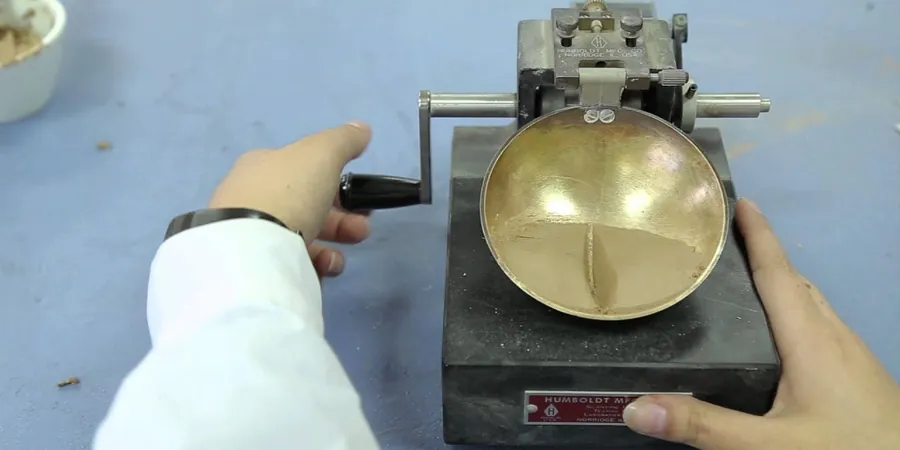
Liquid limit by Casagrande method, plastic limit by hand-rolling, and plasticity index per ASTM D4318. Includes the flow curve plot and USCS classification. Typical turnaround is 3 business days for routine projects in the El Paso metro area.
Expansive Soil Screening
Focused Atterberg testing on multiple depths to map the active zone moisture sensitivity. Combines PI data with natural moisture profiles to assess swell potential under the IBC expansive soil framework. Frequently requested for slab-on-grade designs east of Loop 375.
Typical parameters
Frequently asked questions
How much does Atterberg limits testing cost in El Paso?
A standard liquid limit and plastic limit determination on a single sample typically runs between US$70 and US$110, depending on whether the sample requires extended preparation or if rush turnaround is requested. Multi-sample programs for expansive soil screening are priced per sample with volume discounts.
What is the difference between liquid limit and plastic limit?
The liquid limit is the moisture content at which a soil transitions from a plastic state to a liquid state — measured at 25 blows on the Casagrande cup per ASTM D4318. The plastic limit is the moisture content where the soil stops behaving plastically and crumbles when rolled into a 3.2 mm thread. The plasticity index is the numerical difference between them and is the key parameter for classifying fine-grained soils in the USCS system.
How long does Atterberg testing take?
Standard turnaround is 3 business days from sample receipt. The limiting step is air-drying the soil to a workable moisture range; oven-drying is avoided because it can alter the clay mineral structure and produce misleading Atterberg values, especially in the smectitic clays common in the El Paso basin.
Which El Paso soils typically show high plasticity index values?
The highest PI values in the El Paso area come from clay layers within the Santa Fe Group and from fine-grained facies of the Camp Rice Formation, particularly east of the Franklin Mountains. These montmorillonite-rich clays can produce PI values above 35 and are responsible for most expansive-soil foundation distress in neighborhoods like Eastwood Heights and Cielo Vista.