ASTM D698 and D1557 define the moisture-density relationship that governs fill placement across El Paso’s basins. Between the Franklin Mountains and the Rio Grande floodplain, native soils range from clean windblown sands to stiff, gypsiferous silts — materials that compact very differently under the same roller pass. Without a Proctor curve tied to the actual borrow source, density specs become guesswork and rework costs compound fast. Our team runs both Standard Proctor (12,400 ft-lbf/ft³) and Modified Proctor (56,000 ft-lbf/ft³) in an AASHTO-accredited lab, returning curves and optimum moisture content within 72 hours. For sites with variable fill we pair the Proctor with a sand cone density test to verify field compaction against the lab target during lift placement.
A Proctor curve isn't just a lab number — it's the target your roller operator needs at 6 a.m. when the first lift hits the grade.
Methodology and scope
Local considerations
El Paso sits at roughly 3,740 feet elevation, with summer monsoon storms that can dump an inch of rain in 30 minutes on sun-baked, hydrophobic fill. A compaction curve developed on oven-dried lab samples misses what happens when a half-built pad gets soaked overnight. We see this most often in the Northeast’s developing foothill subdivisions, where silty sand fills lose bearing fast if placed more than 2% above optimum. The risk isn't just re-testing — it's a failed proof roll, a stopped pour, and a general contractor back-charging the earthwork sub. On TXDOT-funded road jobs, the spec is almost always Modified Proctor with method C (6-inch mold), and the tolerance band is tight: 95% minimum, ±2% of optimum moisture. Missing that window by half a percent stops the paver. Combine the Proctor with a CBR test for road subgrade when the pavement design demands a strength calibration tied to the same compactive effort, and you eliminate the disconnect between lab density and structural stiffness.
Explanatory video
Applicable standards
ASTM D698-12(2021) — Standard Proctor, ASTM D1557-12(2021) — Modified Proctor, ASTM D4718-15(2020) — Oversize Correction, ASTM D2216 — Moisture Content, TxDOT Tex-113-E / Tex-114-E
Associated technical services
Standard Proctor (ASTM D698)
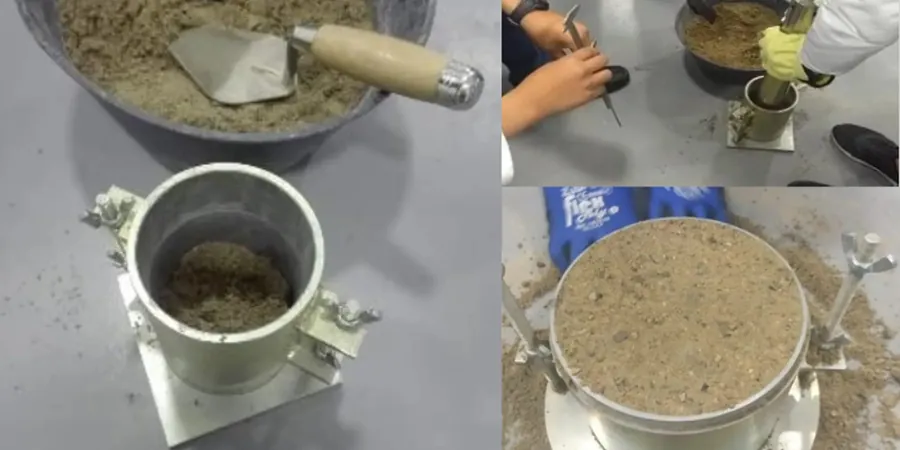
Four-point curve with 5.5-lb hammer, 12-inch drop. Typical for landscape fills, utility trench backfill, and lightly loaded slabs.
Modified Proctor (ASTM D1557)
Six-point curve with 10-lb hammer, 18-inch drop. Required for TXDOT road subbase, structural fill under footings, and airfield pavement.
One-Point Field Proctor Check
Rapid verification using a single point against the established family of curves. Useful when borrow source changes mid-shift.
Oversize Rock Correction
ASTM D4718 adjustment when plus-3/4-inch material exceeds 5%. Critical for caliche and river-run gravel fills common in the Rio Grande valley.
Typical parameters
Frequently asked questions
What's the difference between Standard and Modified Proctor, and which one does my El Paso project need?
Standard Proctor uses 12,400 ft-lbf/ft³ of compactive energy; Modified uses 56,000. For most commercial building pads and residential slabs in El Paso, Standard is acceptable. TXDOT roadwork, bridge approaches, and heavily loaded industrial floors almost always require Modified. If your geotechnical report doesn't specify, we'll review the structural loads and recommend the appropriate method before running the test.
How much does a Proctor test cost in El Paso?
A single-point Proctor (Standard or Modified) with full moisture-density curve typically runs between US$110 and US$190, depending on whether oversize correction is needed and how many points the curve requires. We quote a firm price after seeing the material gradation.
How long does it take to get results back?
Standard turnaround is 48 to 72 hours from sample receipt. Expedited 24-hour processing is available for active earthwork operations where the roller is waiting on the curve. We email the PDF report with the plotted curve, ZAV line, and optimum moisture/density values the moment the final data point dries.
Can you test material with gravel and cobbles larger than 3/4 inch?
Yes. We apply the ASTM D4718 correction when the plus-3/4-inch fraction exceeds 5%. For material with significant oversize, we use the 6-inch mold and adjust the compaction energy per the standard. Caliche fills across El Paso frequently trigger this correction, and we've run hundreds of corrected curves for local contractors.