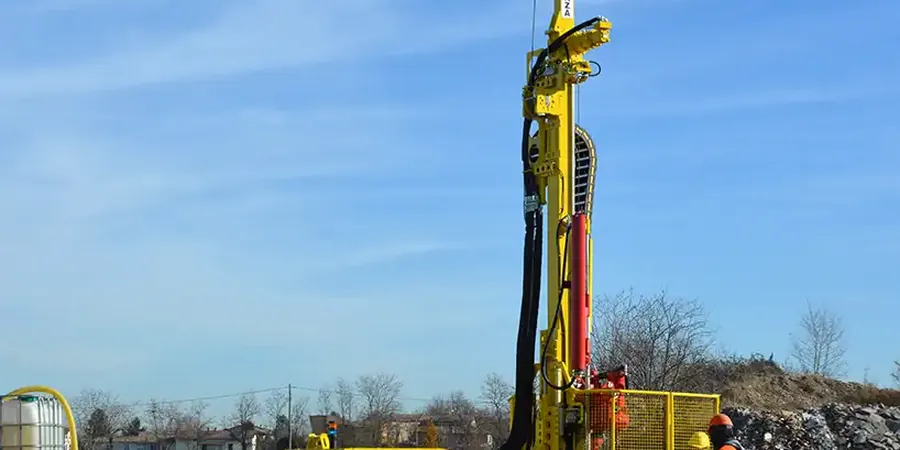
El Paso's growth didn't happen by accident. The city pushed across the Rio Grande floodplain, climbed the Franklin Mountain foothills, and spread east into the desert basin, all on wildly different soil profiles. Anyone who has drilled near the old smelter site or up toward Transmountain Road knows the subsurface changes fast — dense gravels in one hole, loose silty sand in the next. That kind of variability is exactly why the SPT (Standard Penetration Test) remains our go-to exploration method here. When we mobilize a rig to a site in El Paso, we're not just counting blows; we're reading the soil story behind every 6-inch increment. Understanding that story often requires pairing SPT data with a grain-size analysis to confirm fines content, especially in alluvial zones where classification by feel alone can mislead the foundation engineer.
An N-value alone won't tell you if that sand will settle or hold — but combined with local basin knowledge, it's the most reliable number on the log.
Methodology and scope
Local considerations
At roughly 3,740 feet above sea level, El Paso sits on a structural basin where the Rio Grande Rift has been dropping sediments for millions of years. That geologic history leaves us with clean sands, silty layers, and intermittent gravel stringers that complicate SPT interpretation. The biggest risk we see isn't refusal itself — it's misreading refusal caused by a single cobble versus a true dense layer. In the downtown area near I-10, old undocumented fill adds another variable; blow counts can look great on paper but the material beneath might be poorly compacted debris. Missing these nuances leads to overconfident bearing capacity assumptions. That's why we insist on logging recovery, noting sampler damage, and cross-checking SPT results with site geology before anyone puts a footing elevation on a drawing.
Applicable standards
ASTM D1586-18: Standard Test Method for Standard Penetration Test (SPT) and Split-Barrel Sampling of Soils, IBC Chapter 18: Soils and Foundations (adopted by City of El Paso), ASCE 7-22: Minimum Design Loads and Associated Criteria for Buildings and Other Structures
Associated technical services
SPT Boreholes for Shallow and Deep Foundations
Continuous SPT sampling at 5-foot intervals, with depth adjusted for spreads, mats, or deep pile groups. We handle traffic control and permits on El Paso rights-of-way.
SPT with Complementary Index Testing
Split spoon samples bagged, logged, and routed to our lab for sieve analysis and Atterberg limits, giving you a full ASTM D2487 classification plus N-values in one report.
Typical parameters
Frequently asked questions
What does an SPT cost for a typical residential lot in El Paso?
For a standard single-family lot inside city limits, SPT drilling with two to three boreholes generally runs between US$530 and US$730, depending on depth, access, and whether we're coordinating a backhoe for utility clearance. Deeper commercial borings or sites requiring traffic control will shift that range upward, but we can usually give a firm number after a quick site visit.
How deep do SPT boreholes need to go for a slab-on-grade in El Paso's expansive clay areas?
In the clay-rich basin deposits we see across much of central and northeast El Paso, we typically extend SPT boreholes to at least 15 to 20 feet, and deeper if the geotechnical engineer wants to evaluate moisture variation with depth. The goal isn't just bearing — it's catching the zone where seasonal shrink-swell potential tapers off so the slab design accounts for it properly.
Can you perform SPT testing inside an existing warehouse or building?
We can, using limited-access rigs that fit through standard bay doors. Headroom and ventilation become the main constraints, and we'll need a pre-drilling survey for underground utilities. We've done this inside older manufacturing buildings near the border and at distribution centers on the east side without shutting down operations.