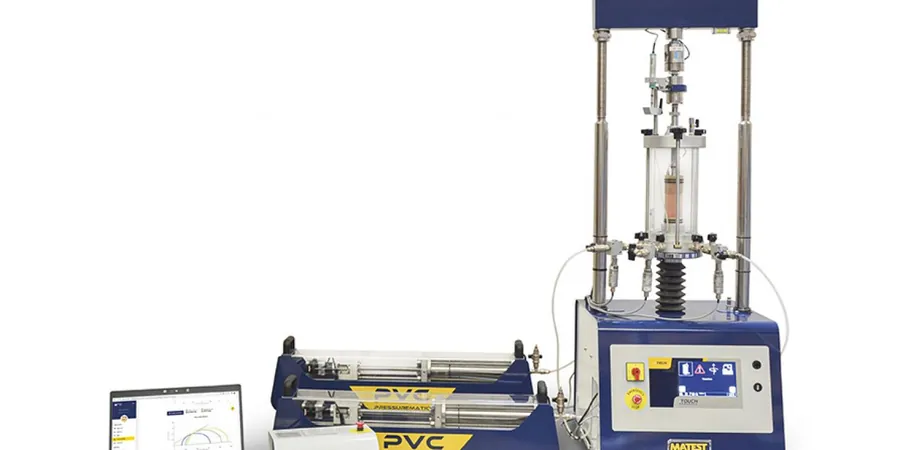
In El Paso, the transition from basin sediments to mountain-front alluvial fans means soil strength can shift dramatically within a single jobsite. Our lab runs consolidated-undrained and unconsolidated-undrained triaxial tests to pin down effective stress parameters that standard penetration data alone cannot provide. The Franklin Mountains shed coarse angular gravels into finer desert silts, and the resulting interlocking fabric often yields friction angles higher than textbook values would predict. Understanding the true shear behavior of these materials under controlled drainage conditions is not a luxury when designing deep excavations or retaining structures near the Rio Grande floodplain. For sites where rapid loading during construction is a concern, we often pair triaxial test results with field-derived data from CPT testing to cross-validate the undrained shear strength profile before finalizing bearing capacity calculations.
Effective friction angles in El Paso’s mountain-front alluvium often exceed 38 degrees when tested under triaxial conditions—values that can significantly optimize foundation dimensions.
Methodology and scope
- Consolidated-undrained (CU) with pore pressure measurement per ASTM D4767
- Unconsolidated-undrained (UU) for rapid loading scenarios per ASTM D2850
- Effective stress friction angle and cohesion intercept from Mohr-Coulomb envelopes
- Stress path analysis to distinguish contractive versus dilative behavior
Local considerations
El Paso’s growth in the 1950s pushed residential and commercial development onto the lower terraces of the Rio Grande Valley, where fine-grained deposits of the Fort Hancock Formation can contain lenses of saturated silt that are susceptible to strength loss under shear. A total-stress triaxial test run on an undisturbed sample from these depths often reveals a friction angle below 26 degrees when the material is sheared undrained, a value that would be missed by correlations based solely on blow counts. The risk is compounded where irrigation canals and historic acequias have altered the local groundwater regime over decades, creating perched water tables that change effective stress conditions seasonally. Ignoring these nuances by relying on assumed strength parameters has led to excessive settlement and, in a few documented cases, bearing capacity failures beneath lightly reinforced footings in the Lower Valley area.
Applicable standards
ASTM D4767-11: Standard Test Method for Consolidated Undrained Triaxial Compression Test for Cohesive Soils, ASTM D2850-15: Standard Test Method for Unconsolidated-Undrained Triaxial Compression Test on Cohesive Soils, ASTM D7181-20: Method for Consolidated Drained Triaxial Compression Test for Soils, AASHTO T-297: Standard Method of Test for Consolidated-Undrained Triaxial Compression Test
Associated technical services
CU Triaxial with Pore Pressure Measurement
Consolidated-undrained testing on saturated fine-grained soils to obtain effective stress shear strength parameters c’ and φ’, plus excess pore pressure response during undrained loading.
UU Triaxial for Rapid Loading Analysis
Unconsolidated-undrained triaxial compression for total stress analysis in short-term construction conditions, such as embankment placement over soft ground.
Stress Path and Modulus Evaluation
Detailed interpretation of triaxial data including stress path plots in p–q space, secant modulus at 50 percent strain (E50), and Skempton’s pore pressure coefficient at failure (Af).
Typical parameters
Frequently asked questions
How many triaxial specimens do you need from an El Paso site?
We typically request three undisturbed specimens per soil stratum to define a Mohr-Coulomb failure envelope at three different confining pressures. For heterogeneous alluvial deposits common west of the Franklin Mountains, the project geotechnical engineer may specify additional specimens to capture the variability in gravel content and fines percentage.
What is the typical turnaround time for a triaxial test report?
A standard set of three CU triaxial tests with pore pressure measurement and full stress path interpretation is delivered in 10 to 14 business days from sample arrival. Specimens requiring longer saturation times due to low-permeability silts from the Fort Hancock Formation may extend the schedule by a few days.
How much does a triaxial test program cost in El Paso?
A triaxial testing program generally ranges from US$2,100 to US$2,560 for a set of three specimens, depending on whether consolidated-undrained or unconsolidated-undrained conditions are specified and the level of reporting detail required by the design engineer.
Can you run triaxial tests on gravelly soils from the El Paso basin?
Triaxial testing on gravelly soils is feasible if the maximum particle size does not exceed one-sixth of the specimen diameter, which for our 70 mm specimens limits gravel to roughly 12 mm. Coarser alluvial fan material from the Franklin Mountain bajadas often requires larger-diameter specimens or alternative field testing methods.