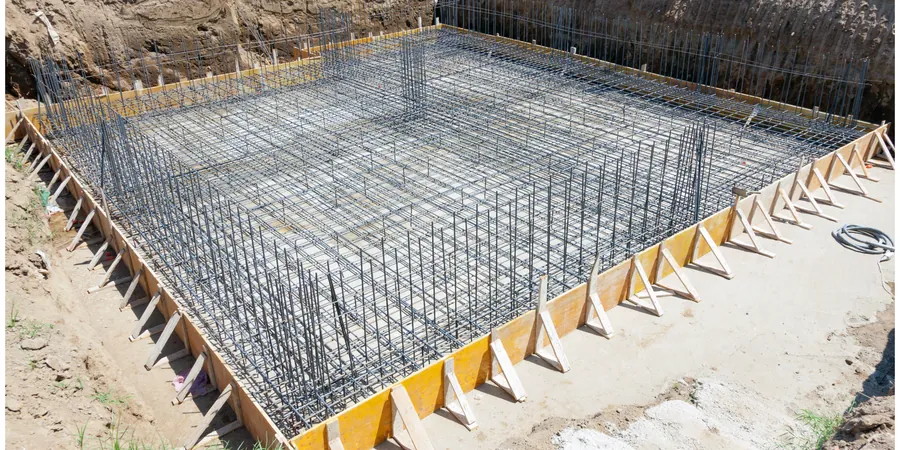
El Paso's elevation ranges from 3,700 to nearly 6,000 feet across its basin-and-range topography, exposing foundations to drastic thermal swings and desiccated clay profiles that move seasonally. The Chihuahuan Desert climate, with less than 9 inches of annual rainfall, creates soil moisture regimes where expansive behavior can produce vertical heave exceeding 2 inches in low-density silty clays—enough to fracture a conventional footing system. A properly executed raft foundation distributes structural loads across a continuous slab, bridging soft spots and reducing differential settlement in the variable alluvial fan deposits that underlie much of the city. Our geotechnical team evaluates these site-specific conditions through rigorous subsurface investigation before recommending mat geometry, reinforcement scheduling, and bearing depth.
A well-designed raft foundation in El Paso's basin fill can reduce total settlement by 40–60 percent compared to isolated footings on the same expansive clay profile.
Methodology and scope
Local considerations
Over twenty years of forensic review in the El Paso area reveals a recurrent pattern: edge lift on the west side of slabs built over thin clay layers that dry out under afternoon sun, while the east side remains in shade and retains moisture, creating a permanent camber in the foundation. This differential movement is rarely captured by a single borehole or a generic presumptive bearing value. When the geotechnical investigation skips deep sampling through the entire active zone—typically 15 to 20 feet in these semi-arid clays—the raft design may be based on moisture conditions that do not represent the long-term equilibrium state. Another frequent oversight is ignoring the effect of landscape irrigation after construction, which reintroduces water into previously desiccated profiles and triggers heave that the slab was never designed to resist.
Applicable standards
IBC 2021 – Chapter 18: Soils and Foundations, ASCE 7-22 – Minimum Design Loads and Associated Criteria for Buildings, ACI 318-19 – Building Code Requirements for Structural Concrete, ASTM D4546 – One-Dimensional Swell or Collapse of Soils, ASTM D2487 – Unified Soil Classification System (field & lab), PTI DC10.5 – Standard Requirements for Design of Shallow Post-Tensioned Foundations on Expansive Soils
Associated technical services
Subsurface Exploration & Sampling
Rotary wash and hollow-stem auger drilling to depths of 25–40 feet, with SPT sampling per ASTM D1586 at 5-foot intervals and undisturbed Shelby tube recovery in cohesive strata for swell-consolidation testing.
Laboratory Soil Characterization
Determination of Atterberg limits, particle-size distribution, modified Proctor density, and one-dimensional swell-collapse potential under varying moisture conditions, all conducted under the laboratory's ISO/IEC 17025 scope.
Finite Element Mat Design
Three-dimensional modeling of soil-structure interaction using modulus of subgrade reaction profiles derived from site-specific data, with output including slab thickness, reinforcement layout, and predicted long-term deflection contours.
Typical parameters
Frequently asked questions
What is the typical cost range for a raft foundation geotechnical design package in El Paso?
For a single-family residential or light commercial structure, the complete geotechnical investigation and raft design package typically falls between US$900 and US$3,910, depending on the number of borings, laboratory tests required, and the complexity of the finite element analysis.
How does the expansive clay in El Paso affect raft foundation thickness?
Expansive clays with plasticity indices above 25 generate significant edge-lift and center-heave moments. The raft thickness is calibrated using the PTI method or equivalent beam-on-mound analysis so that the slab stiffness counteracts the predicted swell pressure, often resulting in thickened perimeters and interior stiffening ribs.
Is a raft foundation suitable for El Paso's Seismic Design Category D sites?
Yes, provided the design incorporates the kinematic soil-structure interaction effects defined in ASCE 7-22 Chapter 19. The mat acts as a rigid diaphragm, and when detailed with proper reinforcement at the column interfaces, it performs well in transferring inertial forces to the ground without the differential settlement that can affect isolated footings during strong shaking.